
How AI Will Reshape Small and Mid-Sized Manufacturing Over the Next 5 Years

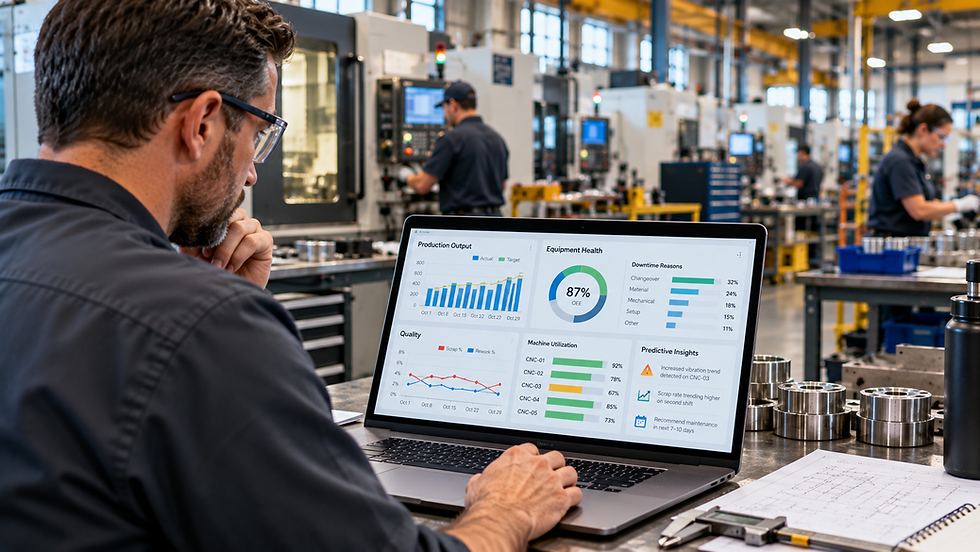
Artificial intelligence is becoming increasingly accessible to small and mid-sized manufacturers. What once required significant investments in specialized software, infrastructure, and technical expertise is now becoming available through tools that can work alongside existing manufacturing systems.
Over the next five years, AI has the potential to change how manufacturers manage equipment reliability, production scheduling, quality, and operational performance.
But the greatest opportunity isn't necessarily replacing people or automating entire facilities. It's helping manufacturers make better decisions, identify problems earlier, and get more value from the resources they already have.
Where AI Will Have the Greatest Impact
1. Predictive Maintenance and Equipment Reliability
Unplanned equipment downtime can disrupt production schedules, increase overtime, and create costly delivery delays.
AI-enabled maintenance systems can analyze equipment conditions, operating history, and performance trends to identify potential failures before they occur.
For manufacturers with reliable equipment data, this could mean:
Fewer unexpected breakdowns
Better maintenance planning
Reduced emergency repair costs
Improved equipment availability
However, predictive maintenance doesn't require every manufacturer to immediately invest in advanced sensors or connected equipment.
A practical starting point is improving how downtime, maintenance history, and recurring equipment failures are recorded and analyzed.
2. Quality Improvement and Scrap Reduction
Manufacturers often collect significant amounts of quality data without fully understanding the relationships between defects, operating conditions, and production performance.
AI can help identify patterns across variables such as machine settings, material lots, production shifts, and environmental conditions.
For example, a manufacturer experiencing recurring scrap might discover that defects increase under a particular combination of machine settings and material characteristics.
These insights can help quality and operations teams investigate problems more effectively.
AI doesn't eliminate the need for root cause analysis. It helps teams identify where to focus their efforts.
3. Smarter Production Scheduling
Production scheduling is one of the most challenging activities in many manufacturing operations.
Material shortages, equipment availability, labor constraints, and changing customer priorities can quickly make a production schedule obsolete.
AI-assisted scheduling tools can evaluate multiple scenarios and help planners understand the potential impact of different decisions.
This could include identifying:
Better production sequences
Opportunities to reduce changeovers
Potential capacity constraints
Delivery risks before they become critical
For smaller manufacturers, the value isn't necessarily fully automated scheduling. It's giving planners better information to make faster, more informed decisions.
4. Turning KPI Data Into Actionable Insights
Many manufacturers already have access to production data through ERP systems, spreadsheets, and reporting platforms.
The challenge is often turning that information into meaningful action.
AI can help analyze operational performance and identify trends that might otherwise be overlooked.
Imagine a weekly production report that automatically highlights:
Equipment with increasing downtime
Changes in scrap or rework trends
Declining productivity
Emerging delivery performance risks
Instead of spending hours compiling and interpreting reports, operations leaders can spend more time understanding problems and taking corrective action.
This is one of the more practical near-term opportunities for small and mid-sized manufacturers because it can build on information they already collect.
Why Smaller Manufacturers Have an Opportunity
Large manufacturers often have more resources to invest in advanced technology, but smaller organizations can have advantages of their own.
With fewer organizational layers, they may be able to test new tools, make decisions, and implement improvements more quickly.
A manufacturer doesn't need a multimillion-dollar AI initiative to create value.
A relatively simple application that reduces reporting time, identifies recurring downtime patterns, or improves scheduling decisions can provide meaningful operational benefits.
The key is selecting a specific business problem rather than adopting technology simply because it's available.
Data Integrity: The Foundation of Effective AI
One of the most important considerations when introducing AI into manufacturing is the quality and integrity of the underlying data.
The principle is straightforward: Good data in, good insights out. Bad data in, bad insights out.
AI can process enormous amounts of information and identify patterns that may not be immediately obvious. But if that information is incomplete, inconsistent, or inaccurate, the resulting analysis can be misleading.
Consider a manufacturer using AI to analyze equipment downtime.
If operators record downtime reasons inconsistently, or if certain events aren't captured at all, the system may identify the wrong causes of lost production time.
The technology may be working exactly as designed, but the conclusions are only as reliable as the information being analyzed.
Before relying on AI to support operational decisions, manufacturers should ask:
Are downtime reasons recorded accurately and consistently?
Are production counts and cycle times reliable?
Are scrap and quality classifications standardized?
Do teams trust the KPIs being reported?
Are there clear processes for validating and correcting data?
Data integrity isn't simply an IT responsibility. It starts on the manufacturing floor, where information is collected, recorded, and used to make daily decisions.
Even with reliable data, AI-generated findings should be validated against actual operating conditions. Experienced operators, supervisors, and engineers remain essential to interpreting results and determining the appropriate actions.
AI can accelerate analysis, but it cannot replace the discipline required to build reliable operational information.
The same principle applies to operational processes. AI cannot compensate for unclear responsibilities, poorly designed workflows, or a lack of accountability.
Strong operational fundamentals make technology more valuable, not less necessary.
Where Manufacturers Should Start
For most small and mid-sized manufacturers, the best approach is to start small and expand based on measurable results.
Step 1: Identify a Recurring Operational Problem
Choose an issue that affects cost, delivery, quality, or productivity.
Start with a problem worth solving rather than searching for an opportunity to use AI.
Step 2: Evaluate Data Readiness
Determine whether the information needed to understand the problem is accessible, accurate, and consistent.
If the data isn't reliable, improve the collection and validation process before introducing more advanced analysis.
Step 3: Test a Focused Application
Start with one production area, one reporting process, or one recurring issue rather than attempting a facility-wide implementation.
A limited pilot makes it easier to evaluate the technology, manage risk, and understand the potential return.
Step 4: Measure the Results
Evaluate whether the application improves decision-making, reduces administrative effort, or contributes to measurable operational improvement.
The objective should be operational performance, not simply technology adoption.
Step 5: Expand What Works
Build on successful applications while maintaining clear ownership, data security, and operational discipline.
As confidence and capabilities grow, additional applications can be introduced where they provide meaningful value.
The Next Five Years
AI will likely become a more common part of everyday manufacturing management.
Production reports will become easier to interpret. Maintenance teams will have better tools for identifying equipment risks. Scheduling decisions will increasingly benefit from predictive analysis.
However, technology alone won't determine which manufacturers perform best.
The organizations that benefit most will be those that combine new capabilities with reliable data, strong operational processes, engaged employees, and consistent improvement practices.
Manufacturers don't need to wait for a complete digital transformation to begin. They can start by improving the information they already collect, strengthening their daily management systems, and identifying practical opportunities where AI can support better decisions.
The future of manufacturing isn't simply about using more technology. It's about making better operational decisions with the people, processes, and resources already available.
At EVOS Consulting, we believe sustainable operational improvement starts with understanding the process, identifying constraints, establishing reliable performance measures, and building systems that support measurable results.
Evolve. Improve. Thrive.


